PhD students in BioSC Core Groups have the opportunity to apply for interdisciplinary small-scale projects with a six-month duration across different BioSC partner locations and research areas. There are one or two calls for proposals per year.
HybaSC - Single-Cell Analysis of Hydrogel-Encapsulated Bacteria for Seed Coatings
Hannah Küttner, Functional und Interaktive Polymers, RWTH Aachen University
Michelle Bund, IBG-1: Biotechnology | Systems Biotechnology, Forschungszentrum Jülich
Funding period: 01.12.25 - 31.05.2026
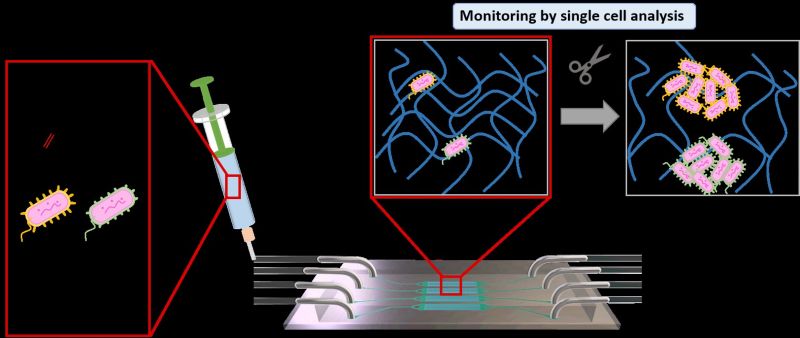
This research aims to reduce microplastic pollution from seed coatings by replacing synthetic polymers with biodegradable, polysaccharide-based microgels that deliver plant-growth-promoting bacteria (PGPB) to seeds presenting a green alternative to conventional fertilizers and pesticides. By encapsulating both gram-positive and gram-negative bacteria in dextran-based gels, the project addresses the challenge of maintaining bacterial viability during storage despite differing moisture needs. It will be examined how different crosslinking densities in hydrogels affect bacterial survival and growth, with the goal of stabilizing bacteria in a dormant state until reactivation. Since single-cell analysis cannot be performed directly in microgels, bulk hydrogels with similar properties are used for these studies, and the generated results will be transferred to microgels. Ultimately, this work supports sustainable agriculture and advances a bio-based circular-economy by providing alternatives to conventional agrochemicals.
PIONEER - Scalable Pseudomonas Phenol Bioduction by Stress Response Engineering
Till Redeker, IBG-1: Biotechnology | Systemic Microbiology, Forschungszentrum Jülich
Constantin Maaß, Biochemical Engineering, RWTH Aachen
Funding period: 01.07.2026 - 31.12.2026
Phenol is a key compound in the chemical industry, serving as a platform chemical for the manufacture of a wide range of products. Since phenol is still predominantly produced from crude oil–based feedstocks, its production represents an ideal example of a conventional chemical process that can be transformed into a more sustainable biotechnological drop-in alternative. As such, it also highlights the strategic importance of biotechnology for advancing the bioeconomy in North Rhine-Westphalia (NRW).
Within PIONEER, we aim to demonstrate the potential of process-oriented biotechnological research by combining expertise in molecular microbiology with industrially focused process development. To this end, Pseudomonas taiwanensis, as a highly solvent-tolerant microorganism, will be engineered into an efficient phenol production host by specifically modulating its stress response. The goal is to identify an optimal balance between intrinsic solvent tolerance and a streamlined cellular stress reaction that supports robust and productive bioprocess performance.
The resulting strain will then be directly evaluated and optimized under application-relevant bioprocess conditions through the identification and adjustment of key process parameters. To fully realize the industrial applicability of this approach, the process will subsequently be scaled up in order to assess enhanced phenol production under industrial operating conditions.
FARMCROP-RR - Farmer Crop Portfolio Choices and the Regional Potential of Crop Residues under Biomass Price Signals in the Rhenish Mining Region
F. Grebe, Economics of Sustainable Land Use and Bioeconomy, University of Bonn
A. Berger, IBG-1: Biotechnology | Systems Biotechnology, Forschungszentrum Jülich
Funding period: 01.07.2026 - 31.12.2026
The FARMCROP-RR project investigates how biomass prices influence farming decisions and, consequently, the availability of agricultural residues as a regional biomass resource. The goal is to analyze the economic conditions under which residues can be mobilized for a sustainable bioeconomy. Based on an extended linear optimization model, optimal crop portfolios are calculated under various biomass price scenarios, and the theoretically available residue potential is derived from these. By combining farm surveys in and around the Rhenish mining region, expert interviews, and economic modeling, more realism regarding assumptions about farmers’ decision-making processes are ensured. The project provides insights into the economic availability of regional biomass, influencing factors such as price incentives and farmer preferences, as well as the planning and scaling of bioeconomic technologies.
About BioSC
Contact
Imprint
Data protection
© BioSC
BioSC-Geschäftsstelle
c/o Forschungszentrum Jülich
52425 Jülich
biosc@fz-juelich.de