Humankind consumes more natural resources in the long term than are available on our planet, particularly in industrialized countries. The concept of the circular economy offers a great opportunity to produce and consume more sustainably. This was the focus of the “Meet the Circular Economy” lecture series, which took place for the fifth time during the 2026 summer semester.
A total of eleven companies presented their sustainability concepts and provided insights into the challenges involved in developing and implementing circular and bio-based processes. Global players were represented alongside startups and small-to-medium-sized firms. Topics included, for example, the decarbonization of the cement industry, the chemical recycling of PET textile fibers, and sustainable process technologies for food production and the utilization of the resulting waste streams.
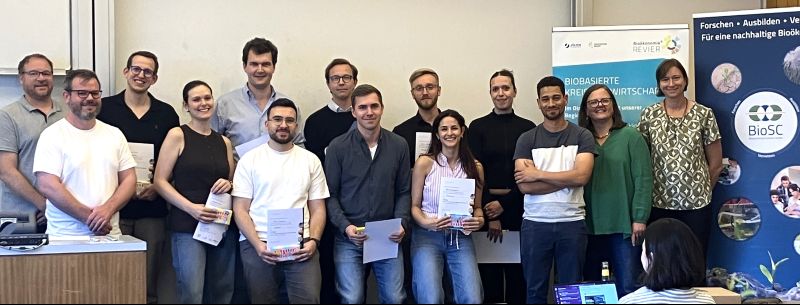
At the concluding Innovation Challenge on July 21, the students competed in teams and presented solutions to current challenges faced by the participating companies. The jury, comprising Prof. Dr. Ingar Janzik (FH Aachen/ Forschungszentrum Jülich/ BioSC), Dr. Florian Siekmann (Forschungszentrum Jülich), and Dr. Tobias Recker and Jeffrey Momoh (both from RWTH Innovation GmbH), honored the three best teams on the basis of creativity, applicability and pitch quality.
The winners were Alexander Dreier, Oscar Pochhammer, and Jan Kietzmann, who had tackled a challenge set by Covestro. They presented a concept designed to enable the large-scale chemical recycling of foam mattresses for the production of new mattresses. For this purpose, they identified companies that already offer services for collecting and shredding used mattresses and for sorting the shredded material, and analyzed potential collaboration opportunities for Covestro.
Second place went to Selin Karaykas, Marc Lauszus, and Sarah Samens for their solution to a challenge posed by the company Remondis. They proposed a business model for maximizing circularity in vehicle manufacturing, designed to keep valuable raw materials within Europe. In this model, the customer pays only for the use of the vehicle. All materials belong to a trust fund, to which they are repeatedly returned in exchange for bonus payments. The main source of revenue for manufacturers would then be the ease of dismantling the vehicles and the recyclability of their parts. Third place went to Tarik Demirkol, Annika Harms, and Maximilian Kalies, who designed a sustainability recommendation tool for Mercedes engineers that takes various factors into account, such as weight, costs, and carbon footprint, as well as mileage and life cycle of the respective cars.
The lecture series “Meet the Circular Economy” has been running since 2022 and is open to the public. It will be offered again next summer semester.
Contact: Prof. Dr. Sandra Venghaus (Economics of Sustainability Teaching and Research Unit)
+49 24180 90963
venghaus[at]sustainability.rwth-aachen.de
www.socecon.rwth-aachen.de/en/lehre/meet-the-circular-economy
 ©Forschungszentrum Jülich
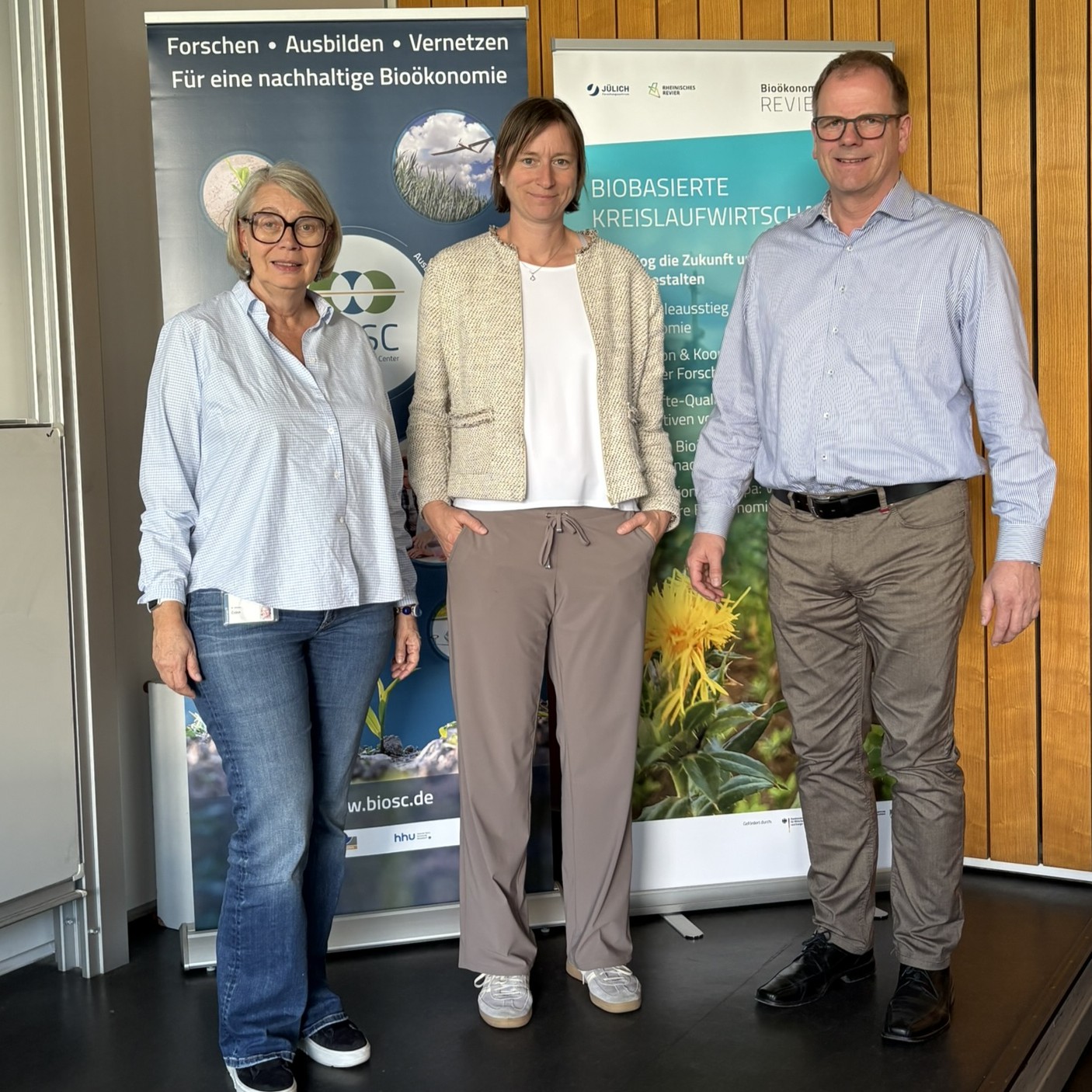
The first session focused on the circular economy in the chemical industry. Dr. Stefanie Eiden presented Covestro’s concept for the circular use of high-performance polymers, which encompasses not only the development of enzymatic, chemical, and pyrolytic recycling processes but also the establishment of new value chains and partnerships. Wolfgang Köster explained WEPA’s approach to manufacturing hygiene products from recycled paper instead of wood and to recycling paper fibers multiple times. Sustainability is addressed throughout the entire production process, for example through the company’s own solar and wind farms. At WEPA, too, establishing economic partnerships—such as with the food retail sector—plays a central role alongside the development of technical processes.
 ©Forschungszentrum Jülich
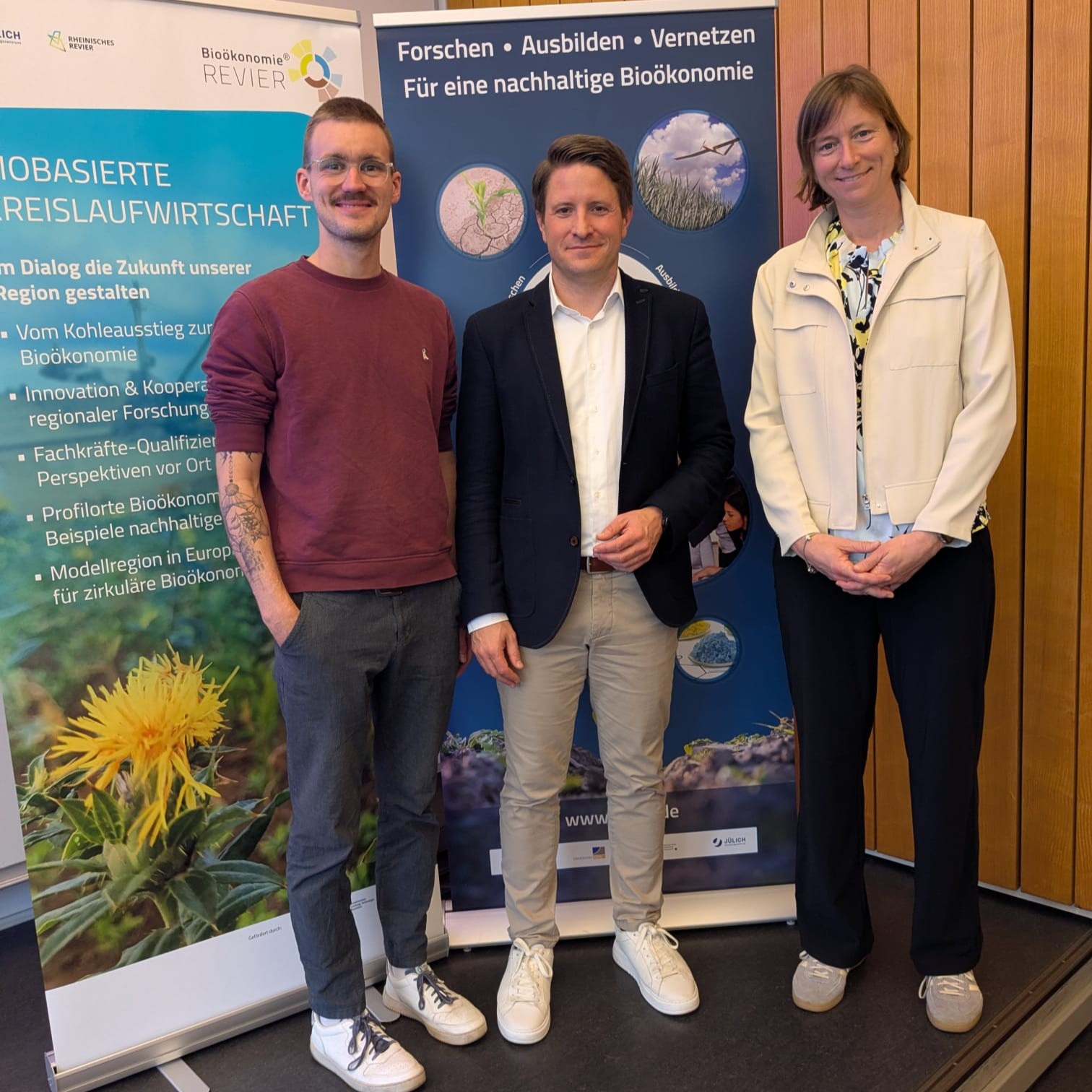
At the second event, Christian Myland of ThyssenKrupp spoke about the possibilities and prospects for decarbonizing the cement industry, which accounts for 7–8% of anthropogenic CO2 emissions. New CO2 capture processes for cement production are almost ready for the market, but would require significant investment and lead to a substantial increase in the cost of cement. Their implementation can only succeed with a social consensus and policy measures. Sebastian Köhne from Schüco presented the production of window profiles made from recycled aluminum, which offer a CO2 reduction potential of up to 87% compared to conventional profiles. The recycling of building materials is often complicated by the fact that they are classified as waste. Nevertheless, Schüco has established the production of window profiles made from “low-carbon aluminum,” which can be offered at nearly the same price as conventional profiles.
 © Foschungszentrum Jülich
On May 13, the third lecture was given by Marcel Gausmann from re.solution. He started his presentatino with a disturbing picture of tons of cloths dumped somewhere in the desert. His company re.solution has made it its mission to solve this problem by tackling the recycling process of old clothes.
Fabrics contain a lot of PET, which would be lost without recycling. The start-up, which has won several prizes including the RWTH spin-off award 2024 and the ACHEMA-Gründerpreis 2024, uses this PET to recover TPA monomers. These monomers can then be used again for the synthesis of textile fibres. Right now, the team around Marcel Gausmann is working on the scaling up process.

During the fourth lecture on June 2, 2026, Vanja Schneider gave a presentation on the activities of Moringa GmbH and the associated environmental and social benefits for urban development. He spoke of the construction industry as the current main driver of resource and energy consumption as well as waste generation. Moringa GmbH aims to transform the construction industry according to the Cradle to Cradle principle. Buildings can ultimately be seen as reservoirs of raw materials whereby individual components can be separated and recycled after use. As an example of this approach in practice, he highlighted an impressive construction project in Hamburg’s HafenCity.
Marcel Kunz introduced the companies TripleSolar and Voltara, which offer heat pumps integrated into photovoltaic panels and hardware and software for home energy systems, respectively. The focus was on the triad of climate protection, economic efficiency, and geopolitical security as the foundation for the development and establishment of a new technology.
 © Forschungszentrum Jülich
On June 23, 2026, Lennart Nübel gave a presentation during the 5th lecture series dealing with the topic “Meet the Circular Economy” from the perspective of REMONDIS. REMONDIS provides environmental and industrial services, covering the areas of recycling, services, and water. In his presentation, he focused on the topics of waste and recycling, emphasizing that the circular economy is a fundamental pillar of raw material extraction in Europe and highlighted regulatory and logistical challenges. He presented reECONIC, a concept vehicle, as a positive example of circular production.
In addition, Camille Vicier and Sarah Straaten presented GEA’s activities that contribute to a circular economy in their presentation titled “GEA for the Circular Economy—From Production Site to Customer Process.” GEA is one of the world’s largest suppliers of systems and components for the food, beverage, and pharmaceutical industries. The international technology group focuses on innovative components, machines, and systems for excellence in resource-efficient production across various areas of daily life, striving to reduce CO₂ emissions, develop options that do not consume fresh water, and provide solutions compatible with the circular economy. As an example of the development of sustainable solutions, the company’s efforts in “Pre2Fuel – Fuels from Waste Oils” were presented.
 © Forschungszentrum Jülich
During the sixth session, Klaus Ruhland presented the Mercedes-Benz sustainability strategy, which is e.g. based on increased electrification and reduced aerodynamic drag in vehicles, the use of green aluminum produced with renewable electricity, and an increase in the recycling rate. While the latter is easily achievable with metals, it is difficult with plastics, as the development of plastics is a highly dynamic field. Chemical recycling would be the most reasonable approach here. A particular challenge lies in comprehensively comparing the environmental impacts of various product concepts and providing clear recommendations for design.
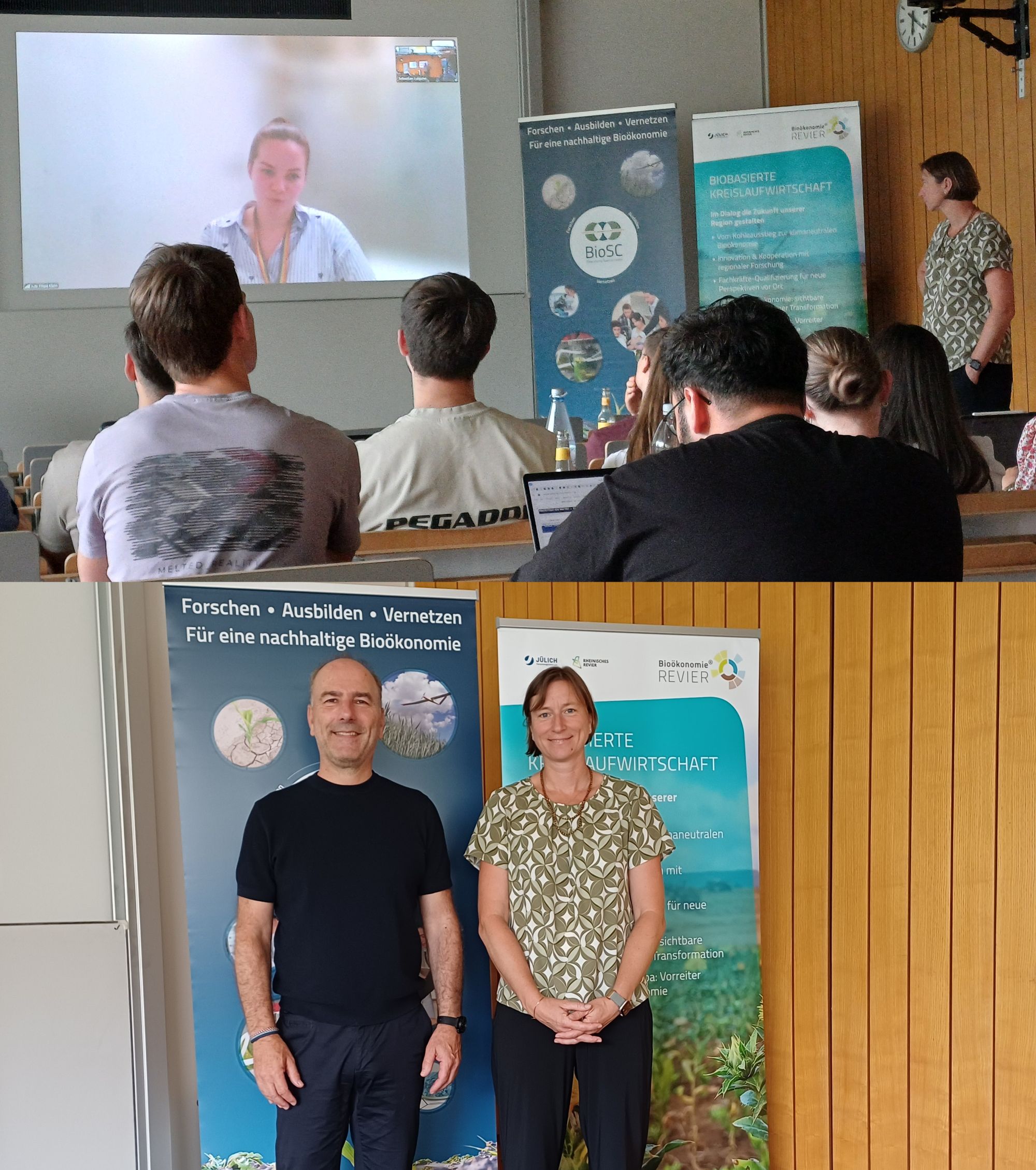
Jule Klein of Discover Airlines spoke about the challenges and opportunities of circular economy in aviation. Recycling materials from decommissioned aircraft poses similar challenges to recycling materials from scrapped cars. In the catering sector, recycling plastic is difficult because meal containers must be incinerated after coming into contact with animal products due to disease control regulations. However, replacing plastic with paper or cardboard leads to even greater volumes of waste in this context. Finally, reducing emissions remains a major challenge, even though kerosene consumption per passenger has been reduced by 50% since the 1990s. Currently, sustainable aviation fuels derived from biomass can cover a maximum of 1% of the kerosene required.
About BioSC
Contact
Imprint
Data protection
© BioSC
BioSC-Geschäftsstelle
c/o Forschungszentrum Jülich
52425 Jülich
biosc@fz-juelich.de