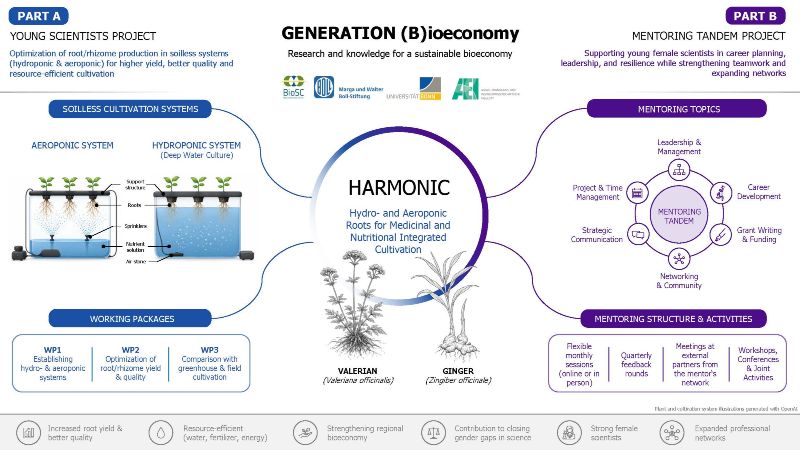
HARMONIC aims to install and improve the hydroponic and aeroponic production of medicinal plants, using valerian (Valeriana officinalis) and ginger (Zingiber officinale) as model crops. The goal is to achieve higher and better-quality root/rhizome yields, conserve resources, and promote regional bioeconomy. Hydroponics and aeroponics enable soilless cultivation with targeted nutrient supply, reduce water and fertilizer use and make production independent of climate and soil conditions. The innovative aspect of the project lies in the targeted use of these systems for root crops in Germany and it is structured into three work packages: (1) establishing and testing of the systems, (2) optimization of root yield and quality, and (3) comparison with field and greenhouse cultivation in terms of yield, quality and resource input. The results will demonstrate the economic and ecological suitability of soilless systems for root crops for medicinal or nutritional use. The scientific program will be accompanied and supervised by an external mentor with extensive scientific experience. And experience in building high-performance teams and guiding them through project planning and execution. The focus is both on the development of the scientist in respect to personal and professional skills and personal development while executing the project plan.
Aim of the mentoring program is to support the mentee’s long-term career development, leadership growth, and personal resilience while fostering strong collaboration between mentor, mentee, and the broader network. The project follows a flexible monthly structure, each session focusing on a distinct theme such as goal setting, project and time management, strategic communication, leadership, funding acquisition and career development. The sessions can be online or live events, integrating exchange with external partners coming from the mentor’s network. Sharing networks and expanding them to the mentee is one major goal of the project. Supplementary activities—such as shared participation in conferences or workshops—are also planned. There are quarterly installed feedback rounds to document the progress and check up on the needs of the team to foster the long-term impact of the program.
Young Scientist and project coordinator
Dr. Katharina Luhmer
INRES - Renewable Resources
University of Bonn
email: kluhmer[at]uni-bonn.de
Mentor
Dr. Ricarda Finnern
email: rfinnern[at]gmx.de
01.04.2026 - 31.03.2029
About BioSC
Contact
Imprint
Data protection
© BioSC
BioSC-Geschäftsstelle
c/o Forschungszentrum Jülich
52425 Jülich
biosc@fz-juelich.de