Summary
Iron deficiency poses a significant challenge in agriculture, affecting plant growth and crop yields. In this context, certain microbes have shown to improve the bioavailability of this essential micronutrient by synthesizing and secreting siderophores – a class of secondary metabolites capable of efficiently chelating insoluble Fe3+. Recent studies have already demonstrated plant growth promoting effects of microbial siderophores under iron-depletion. Therefore, siderophores have tremendous application potential in agriculture as ingredients in alternative fertilizers. However, their native biosynthesis in bacteria is controlled by complex regulatory networks, which hampers functional analysis and biotechnological production.
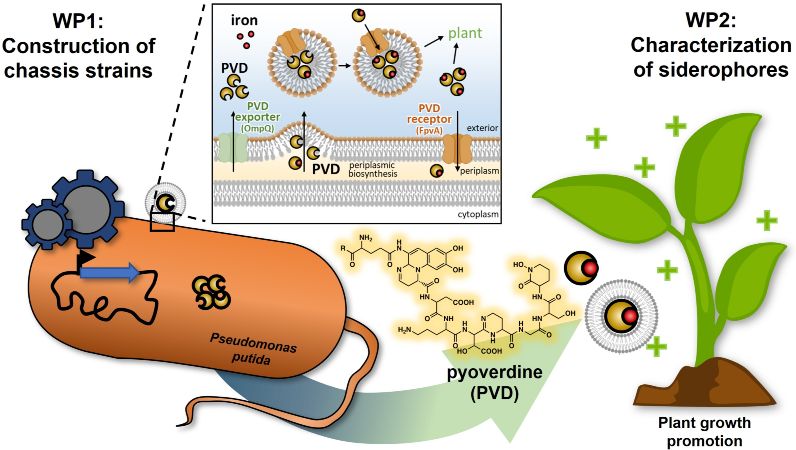
To address this challenge, the BioSC project ProPlantMicro aimed to engineer the microbial host Pseudomonas putida for the efficient production of the siderophore pyoverdine (PVD) to gain access to this class of valuable compounds. In this project, we successfully developed novel P. putida strains for the controlled overproduction of PVD that is independent of intrinsic iron homeostasis control mechanisms. The PVD-enriched supernatants from these cultures, were subsequently tested for their ability to promote plant growth in a modified MS medium enriched with Fe3+ (Fe2O3) to mimic natural soil conditions. It could be demonstrated that PVD-containing supernatants from these strains strongly enhanced plant growth parameters (leaf chlorophyll and root iron content) when applied to roots of Arabidopsis thaliana. These results emphasize pyoverdine's potential in sustainable agriculture as an iron chelator to improve plant growth by facilitating the utilization of insoluble Fe3+ from soil.
In addition, we successfully engineered P. putida strains for increased formation of outer membrane vesicles (OMVs) containing PVD.Initial plant growth promoting studies showed thatOMV-encapsulated PVD was less effective in promoting plant growth probably due to a significantly lower PVD concentration. The data obtained in this study therefor clearly indicate that the plant growth promoting siderophore PVD can be efficiently synthesized and secreted in engineered P. putida production strains. Thus, PVD has great potential as a microbiological alternative to fossil-fuel based iron chelators and can support a sustainable agriculture with respect to iron supplementation in the future.
Dr. Thomas Drepper
IMET - Molecular Enzyme Technology
HHU Düsseldorf
email: t.drepper[at]fz-juelich.de
Dr. Thomas Drepper, IMET - Molecular Enzyme Technology, HHU Düsseldorf
Prof. Dr. Peter Dörmann, IMBIO - Molecular Biotechnology of Plants, University of Bonn
01.10.2023 - 28.02.2025
ProPlantMicro is part of the NRW-Strategieprojekt BioSC and thus funded by the Ministry of Culture and Science of the German State of North Rhine-Westphalia.
About BioSC
Contact
Imprint
Data protection
© BioSC
BioSC-Geschäftsstelle
c/o Forschungszentrum Jülich
52425 Jülich
biosc@fz-juelich.de