Summary
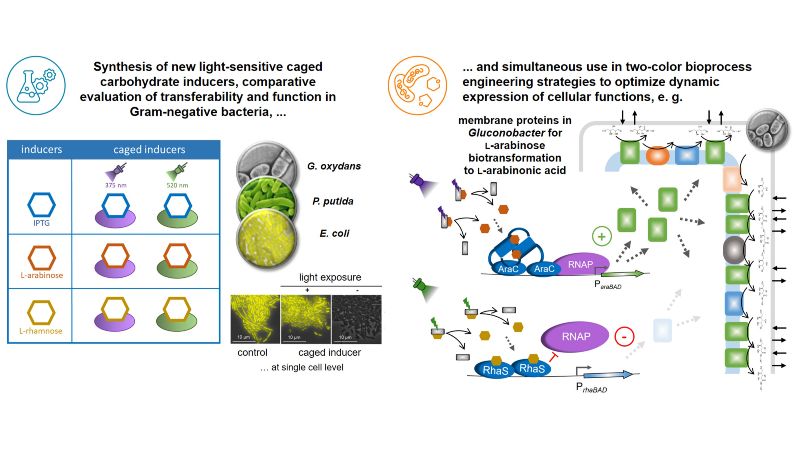
In OpTooGlu the aim was to develop and establish new optogenetic tools for light-controlled gene expression in Gram-negative bacteria including the versatile industrial workhorse Gluconobacter oxydans. The ultimate goal was to establish the simultaneous use of UV-A- and green light-sensitive caged effector molecules of L-arabinose and L-rhamnose for two-color control of defined cellular functions in bacteria, which can be used to develop new bioprocess engineering strategies.
For G. oxydans, we established a robust microfluidic platform for single-cell analysis, enabling quantitative evaluation of growth, morphology, and inducible gene expression. While UV-A-sensitive caged L-arabinose proved non-toxic, its low solubility first limited the application in G. oxydans. To overcome this limitation, it was tested if the uptake can be enhanced in G. oxydans. This was ultimately achieved through the genomic integration of the L-arabinose transporter gene araE from E. coli, which markedly increased the sensitivity of the AraC/ParaBAD expression system in G. oxydans, now enabling efficient induction at 500-fold lower L-arabinose concentrations as low as 0.001 to 0.005 % (w/v) as in E. coli. In addition, AraC/ParaBAD, RhaRS/PrhaBAD, and RhaS/PrhaBAD were comparatively characterized in Pseudomonas putida, E. coli, and G. oxydans to assess their suitability for caged inducers. Using E. coli LMG194 reduced the required L-arabinose concentrations, thereby improving compatibility with poorly soluble caged compounds. To establish an alternative, blue light-responsive photoreceptor system for controlling ParaBAD- and PrhaBAD-dependent target gene expression in bacteria, the recombinant photoreceptor AraBLADE was implemented in E. coli and P. putida and successfully transferred to the RhaS-based expression system enabling blue-light-dependent regulation of gene expression for both species with two ortholog promoter systems. Overall, the project achieved key advances, providing a solid foundation for future two color light-controlled gene expression and bioprocess engineering in the acetic acid bacterium G. oxydans and other Gram-negative bacteria.
Dr. Tino Polen
IBG-1 - Biotechnology
Forschungszentrum Jülich
email: t.polen[at]fz-juelich.de
Prof. Dr. Wolfgang Wiechert, Dr. Dietrich Kohlheyer, Dr. Tino Polen, IBG-1: Biotechnology | Systems Biotechnology, Forschungszentrum Jülich
Prof. Dr. Pietruszka, IBOC - Bioorganic Chemistry, HHU Düsseldorf
Prof. Dr. Thomas Drepper, IMET - Molecular Enzyme Technology, HHU Düsseldorf
01.01.2024 - 28.02.2026
OpTooGlu is part of the NRW-Strategieprojekt BioSC and was thus funded by the Ministry of Culture and Science of the German State of North Rhine-Westphalia.
About BioSC
Contact
Imprint
Data protection
© BioSC
BioSC-Geschäftsstelle
c/o Forschungszentrum Jülich
52425 Jülich
biosc@fz-juelich.de