The PhD-Day “Future Bioeconomy”, hosted by the BioSC and co-organized by BioökonomieRevier, BIGS, CLIB, AUFBRUCH and Humboldtn, at the Dorint Congress Hotel Neuss was again an inspiring day, filled with innovative ideas, forward-thinking technologies, and strong interdisciplinary networking!
It became clear once again how crucial the connection between science, policy, and industry is to drive the transformation toward a bio-based circular economy. Dr. Sonja Brandt from the Ministry of Culture and Science NRW highlighted the state’s goal to develop NRW into a leading bioeconomy hub by 2045, as stated in the new Bioeconomy strategy NRW 2026. A strong signal for the next generation of researchers in the region!


photos: Forschungzentrum Jülich
Session I – Plant & Agricultural Innovations
Dr. Viktor Korzun (KWS Saat) described how broad breeding science is: From genomic selection and AI-driven field analyses to new genomic techniques – depending on the market - seeds are the key to preventing harvest losses by pests and extreme weather conditions. PhD Oluwatosin Abdulsalam (agriBIOME) showed that the use of microbiome can be a milestone to sustainably reduce chemical dependencies in industrial farming through biology.
Session II – Resilient Energy Production & Use
Markus Cremer (SUNfarming / SunnyMushrooms) explained the possibilities of multidimensional land use with Agri-PV—ranging from hydroponics to mushroom cultivation under solar panels as a model for future agriculture.
Session III – Smart Biotechnology
Dr. Philipp Arbter (COLIPI) showed how liquid side streams and CO₂ fermentation can be used for sustainable lipid production and how modular decentralization can be a cost-effective and simple tool in scaling fermentation processes. Dr. Amit Tewari (Henkel) described the "Carbon Intelligence" in surfactant manufacturing— along the example how alternative carbon sources reduce dependencies on palm kernel oil as building block for surfactants and make supply chains more resilient.



photos: Forschungzentrum Jülich
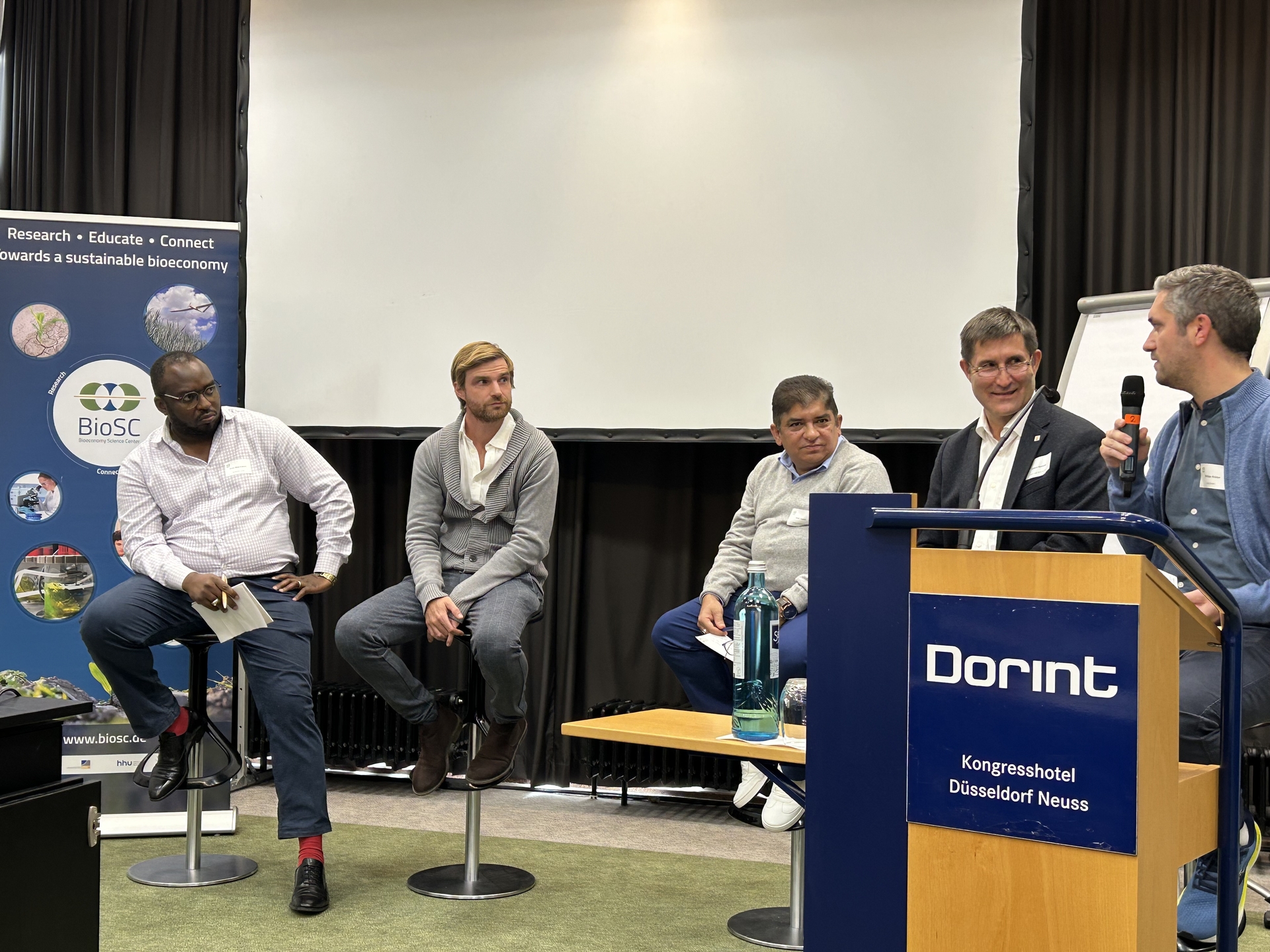
As final session Prof. Ingar Janzik (BioSC) moderated a panel discussion with all speakers of the day with questions from the audience, like which challenges are the most urgent ones, with the highest disruptive impact on Bioeconomy and a Key Takeaway was here: Resilience is born where disciplines connect, system boundaries are challenged, and young research meets established industrial practice.
A big thank you to all co-organizers, the MKW NRW, all speakers, and all the curious PhDs, who made this even to an excellent event!
About BioSC
Contact
Imprint
Data protection
© BioSC
BioSC-Geschäftsstelle
c/o Forschungszentrum Jülich
52425 Jülich
biosc@fz-juelich.de