Microbiomes have crucial roles in maintaining life on Earth, and their functions drive human, animal, plant and environmental health. In the 26th BioSC Lecture, Dr. Tanja Kostic from the Austrian Institute of Technology presented the EU Coordination & Support Action “Microbiome Support” which has established an international network of experts and stakeholders to boost research and innovation in the microbiome food systems research field.
more
Prof. Dr. Nick Wierckx has been awarded one of the prestigious ERC Consolidator Grants. In the PROSPER project, he plans to make Pseudomonas bacteria tolerant to aromatic hydrocarbons such as styrene or benzene in order to be able to produce the latter sustainably through biotechnology. Over a period of five years, he and his team will now receive around two million euros in funding for this purpose. Nick Wierckx is a member of the BioSC.
more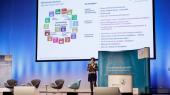
Now in its third year, the "Circular Bioeconomy as an Innovation Driver in Structural Change" was the focus of the BioökonomieREVIER business forum, streamed live from the Medio.Rhein.Erft in Bergheim. With around 200 participants, the afternoon offered different, sometimes unexpected perspectives with high-level keynotes and a multi-faceted look at strategies, opportunities and challenges.
more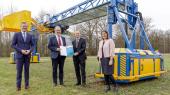
With the founding of the BioökonomieREVIER initiative at the beginning of 2020, 15 „innovation labs“ were also launched. They are intended to facilitate the rapid transfer of new, bio-based approaches from different areas of science into the economy in the structural change in the Rhenish mining area - based on the principles of sustainability. Six of the labs will now receive further funding for up to five years in an innovation cluster called „Innovative Agriculture“ (InnoLa).
more
The Science Year 2020|21 Bioeconomy came to an end on November 29 with a digital closing event looking back on numerous events and funded projects. Among the winners of the 2020 and 2021 university competitions that received awards at the event was the podcast KRAUTNAH from the Institute of Plant Physiology at RWTH Aachen University - one of the contributions to the Science Year coming from BioSC. Another BioSC contribution was the exhibit "Clean Water Through Algae" on the MS Wissenschaft.
more
The Bioeconomy Council of the German Federal Government has published recommendations for a coalition agreement between SPD, Bündnis 90/Die Grünen and FDP on how to achieve the goal of a sustainable societal transformation process to reach the 1.5 degree target.
moreAbout BioSC
Contact
Imprint
Data protection
© BioSC
BioSC-Geschäftsstelle
c/o Forschungszentrum Jülich
52425 Jülich
biosc@fz-juelich.de