Abstract
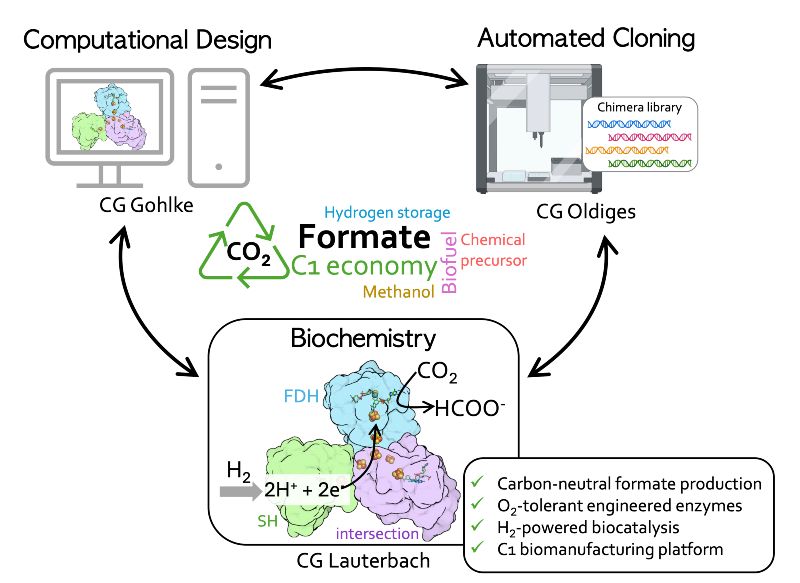
Turning CO2 into a usable feedstock is a central challenge for a climate-neutral bioeconomy. Formate offers a direct solution as a soluble and versatile C1 intermediate that supports synthetic pathways, such as the reductive glycine cycle, and also serves as a precursor for fuels and agro-chemicals. Yet current routes from CO2 to formate remain limited because biological systems are O2-sensitive and chemical methods use harsher conditions. C1Power addresses this by creating hybrid enzymes that couple H2 oxidation directly to CO2 reduction into formate. Using a domainswapping strategy, O2-tolerant hydrogenases and formate dehydrogenases are fused into chimeric enzymes capable of efficient catalysis under oxygen exposure. The project follows an integrated design–build–test–learn cycle that links computational modelling, automated library construction, and high-throughput screening in Cupriavidus necator. The chimera design overcomes two key barriers: (1) avoiding thermodynamically unfavorable electron transfer via NAD(P)+ and (2) overcoming the O2 sensitivity of native systems. This will provide a proof of concept for efficient formate production as the entry point to synthetic CO2 fixation pathways, with formate serving both as a carbon-negative fuel and as a platform intermediate for future value-added chains.
Dr. Paul R.F. Cordero
iAMB Synthetic Microbiology
RWTH Aachen University
email: Paul.Cordero[at]rwth-aachen.de
Dr. Paul R.F. Cordero, Prof. Dr. Lars Lauterbach, iAMB Synthetic Microbiology, RWTH Aachen University
Dr. Benoit David, Prof. Dr. Holger Gohlke, Computational Pharmaceutical Chemistry and Molecular Bioinformatics, Heinrich Heine University Düsseldorf
Prof. Dr. Marco Oldiges, Prof. Dr. Wolfgang Wiechert, IBG-1 Systems Biotechnology, Forschungszentrum Jülich
01.11.2025 - 31.12.2026
C1Power is part of the NRW-Strategieprojekt BioSC and thus funded by the Ministry of Culture and Science of the German State of North Rhine-Westphalia.
About BioSC
Contact
Imprint
Data protection
© BioSC
BioSC-Geschäftsstelle
c/o Forschungszentrum Jülich
52425 Jülich
biosc@fz-juelich.de