Summary
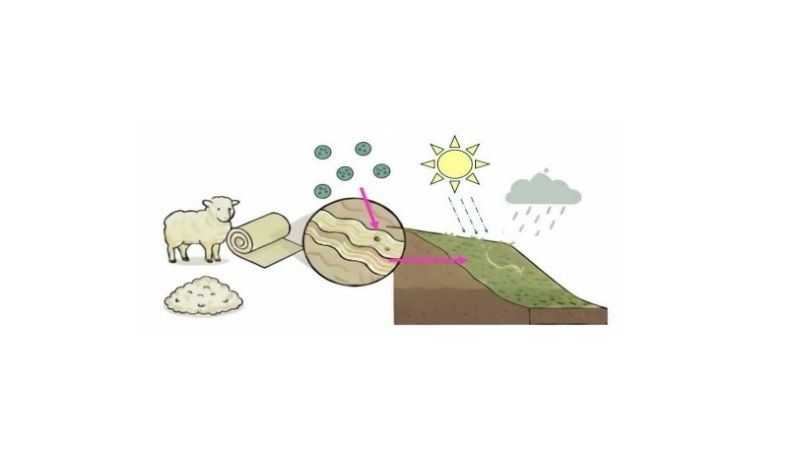
PhotoMat takes a multidisciplinary approach that integrates materials science, organismic biotechnology, and advanced analytical chemistry to develop a biodegradable geotextile for erosion control in post-mining sites in the Rhenish region. The textile will host a functional phototrophic community of prokaryotic and eukaryotic organisms that initiate the formation of biological soil crusts (biocrusts). In biocrusts, soil particles are bound by microbial growth and activity, reducing erosion and facilitating ecological succession. This contributes to long-term soil stabilization while reducing the need for costly technical interventions. To support survival and controlled release, the phototrophs will be encapsulated in alginate beads, providing partial protection from desiccation and enabling moisture-dependent release. The encapsulated inoculum will be embedded in a geotextile made from residual sheep wool, a biodegradable by-product that is sufficiently permeable to allow light penetration, supplies slowly available nutrients, and buffers humidity in the microenvironment. This dual strategy provides a supportive matrix for biocrust establishment, enhancing both the survival of the inoculated organisms and the stability of the developing crust. In summary, PhotoMat delivers a sustainable, low-input solution for restoring degraded soils, not only in the Rhenish region, but with potential for transfer to other erosion-prone landscapes.
Prof. Dr. Ulrich Schurr, IBG-2: Pflanzenwissenschaften, Forschungszentrum Jülich
Prof. Dr. Thomas Gries, Textile Technology and Engineering (ITA), RWTH Aachen
01.01.2026 - 31.12.2026
Photomat is part of the NRW-Strategieprojekt BioSC and thus funded by the Ministry of Culture and Science of the German State of North Rhine-Westphalia.
About BioSC
Contact
Imprint
Data protection
© BioSC
BioSC-Geschäftsstelle
c/o Forschungszentrum Jülich
52425 Jülich
biosc@fz-juelich.de