12th BioSC Spotlight: "Towards a future automated agriculture - From mission to implementation"
July 2, 2026 | 10:00 am - 4:30 pm | Forschungszentrum Jülich
IBG-2: Plant Sciences | 06.2, 406 | 52425 Jülich
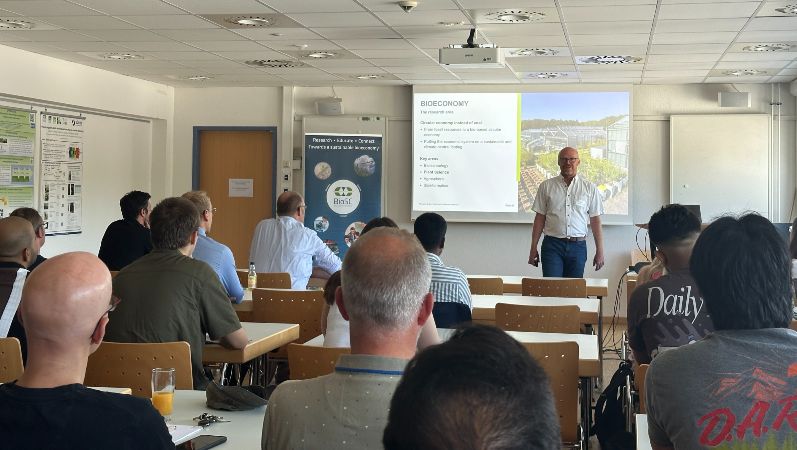
At our recent BioSC Spotlight on 2nd of Juli different speaker from research and industry came together to discuss how artificial intelligence, autonomous robotics, and nature-inspired biopesticides are shifting sustainable farming from a future vision into reality.
These were the highlights of our 3 sessions (Agenda):
Prof. Dr. Anne-Katrin Mahlein (IFZ, Göttingen) opened the event by discussing how digital disease management can help farmers to face dynamic pathogen pressures. Through the "Farmerspace" project, her team uses UAVs and machine learning to analyze single plants in the field. This enables precise spot-spraying based strictly on calculated infection thresholds (e.g., Cercospora on sugar beet), optimizing pesticide application while automatically generating seamless data streams for reporting.
Sandra Bredenbruch (INRES – University of Bonn) addressed the shrinking chemical portfolio in the EU and the urgent need for natural alternatives to combat pesticide resistance. Driven by the "NovoSurf" and "Rhambo" BioSC projects, her research leverages biopesticides like rhamnolipids. These natural compounds offer direct antimicrobial activity and indirect defense mechanisms also against pests like nematodes, whose resilient cysts can otherwise persist in the soil for over 15 years.
Meike Sauerland (HHU Düsseldorf) introduced the "InterPepHerb" project, a highly targeted approach to weed management. Because many aggressive weeds utilize the C4 photosynthetic pathway while most major crops are C3 plants, her team is developing peptide-based, enzyme-specific herbicides that target key C4 enzymes like PPDK While laboratory trials successfully demonstrated germination inhibition, current efforts are focused on improving peptide stability and refining selectivity.
Joint Q&A Takeaway: While these technologies are groundbreaking, regulatory hurdles remain. For instance, Germany’s Plant Protection Act currently prohibits agricultural drone-spraying. Furthermore, for drone systems to become economically viable, cooperative partner models for farmers can be a model.
Maurice Gohlke (farming revolution GmbH) explored how weed control has evolved from manual labor to broad chemical spraying, and now to selective automated weeders. Driven by AI, these advanced machines can precisely identify individual plants. He highlighted that deploying lighter, autonomous robots instead of heavy tractors prevents severe soil compaction, though navigating field obstacles like stones and managing processing throughput remain critical practical challenges.
Dr. Juliane Bendig (IBG2, Forschungszentrum Jülich) demonstrated the power of advanced drone-based remote sensing. Using imgae screening, her research tracks canopy structure and plant height to estimate crop biomass—a method that successfully functions even in fields partly covered by AgriPV-solar panels. By utilizing the AirFLOX system paired with SIF cameras, they can measure localized photosynthetic activity and scale it up to map crop stress across entire fields.
Alireza Ahmadi (Dynamobot GmbH) shared an inspiring PhD-to-startup journey. His company developed as one part the "We See" concept: an intelligent, camera-driven add-on that can be integrated directly onto conventional tractor spray arms. The system dynamically adjusts the sprayer's height and opening angle in real-time, targeting only the weeds and drastically reducing the overall volume of pesticides used.
Harald Kramer (Landwirtschaftskammer NRW) brought a vital reality check regarding on-farm adoption. While digitalization provides brilliant safety solutions—like automated mixing systems that prevent human contact with toxic pesticide concentrates—hardware variations in spray booms can still cause localized volume fluctuations. He highlighted the SAM Dimension offline mapping system, which saves 20-30% in pesticide volume by applying a tight 0.9m spray radius strictly around mapped pest spots.
Prof. Dr. Jan Börner (ILR – University of Bonn) closed the individual talks by shifting the lens to economic and behavioral policy. While profitability is the main driver for technology adoption, a farmer's expectations, peer networks, and social norms play massive roles. Crucially, he explained that sometimes "rebound effects" can occur: when a technology successfully slashes labor costs and boosts productivity, it can inadvertently incentivize the over-expansion of land usage, proving that field-study success must always be weighed against global ecological footprints.
Forschungszentrum JülichForschungszentrum Jülich
Summary & The Way Forward
At the end Prof. Uwe Rascher, head of the hosting institute IBG-2 summarized at the end of the day, looking at the entire innovation pipeline shows us that moving from lab to market requires more than just high crop yields.
AI is no longer a future buzzword: It is actively working in our fields today via computer vision, automated weeders, and remote sensing.
User-centric design is non-negotiable: Researcher and Tech developers must engage with farmers early in the development cycle rather than waiting for a "100% complete" product to ensure it survives real field conditions.
The Framework Matters: True success will depend on aligning technological capabilities with political, financial, and open-source data frameworks to ensure fair and sustainable scalability.
Guided Tours
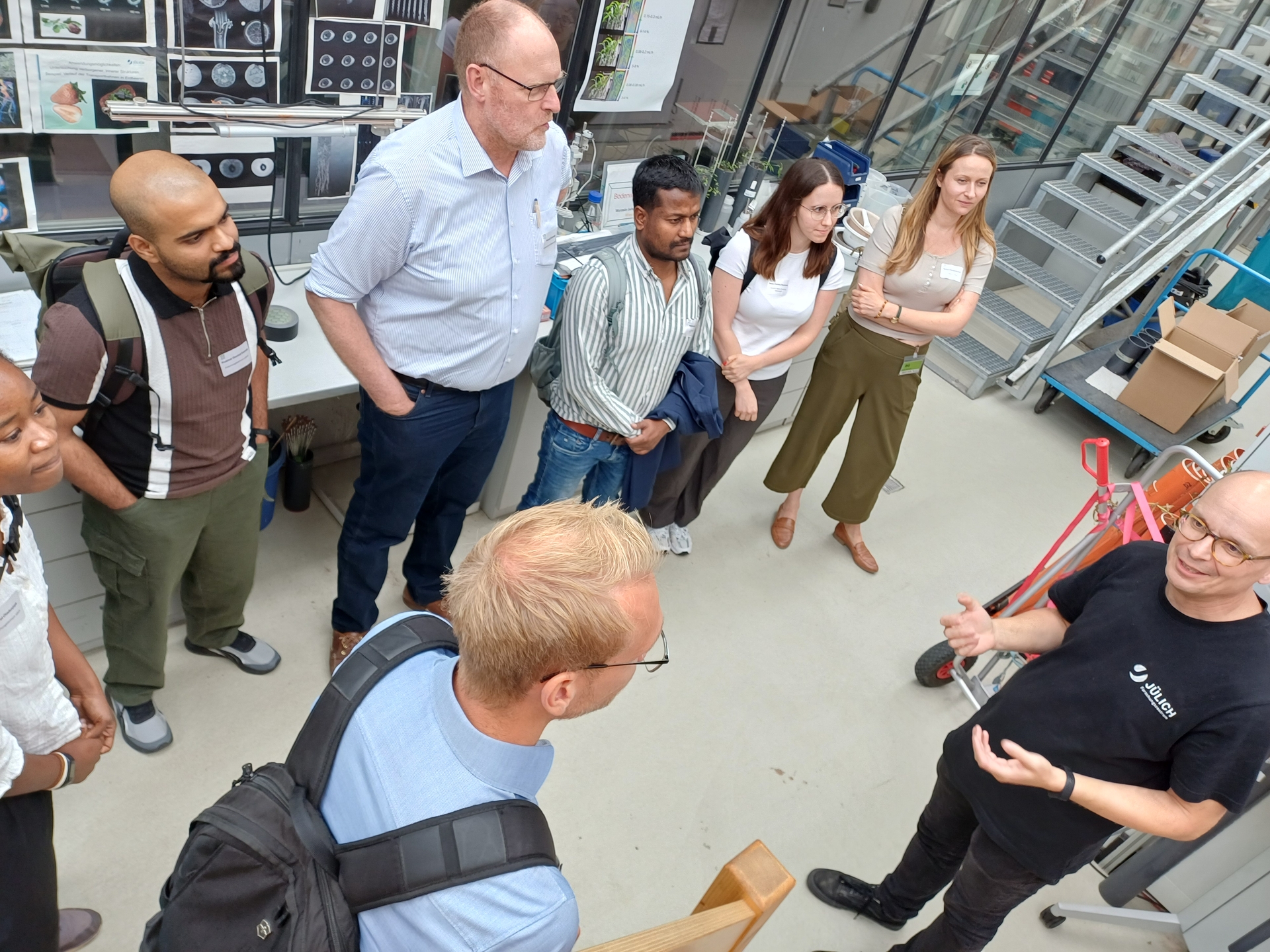
Some participants then toured IBG-2’s specialized phenotyping facilities. Dr. Robert Koller demonstrated the potential of deep root phenotyping using NMR tomography—a non-invasive, long-term technique—and highlighted the advantages of combining it with labeling experiments for non-invasive carbon distribution analyses. Dr. Kerstin Nagel then presented the Rhizo-III facility, demonstrating its capabilities for fully automated, high-throughput shoot and root phenotyping and image analysis across a wide variety of plant species.