Climate-friendly, environmentally sustainable and resource-efficient production of materials and chemicals is one of the current major challenges that the bioeconomy is addressing. The 11th BioSC Spotlight explored the intersections of green chemistry and the bioeconomy and the contributions of green chemistry to a sustainable bio-based circular economy. It took place as a satellite event to the Fuel & Chemical Science Conference 2026.
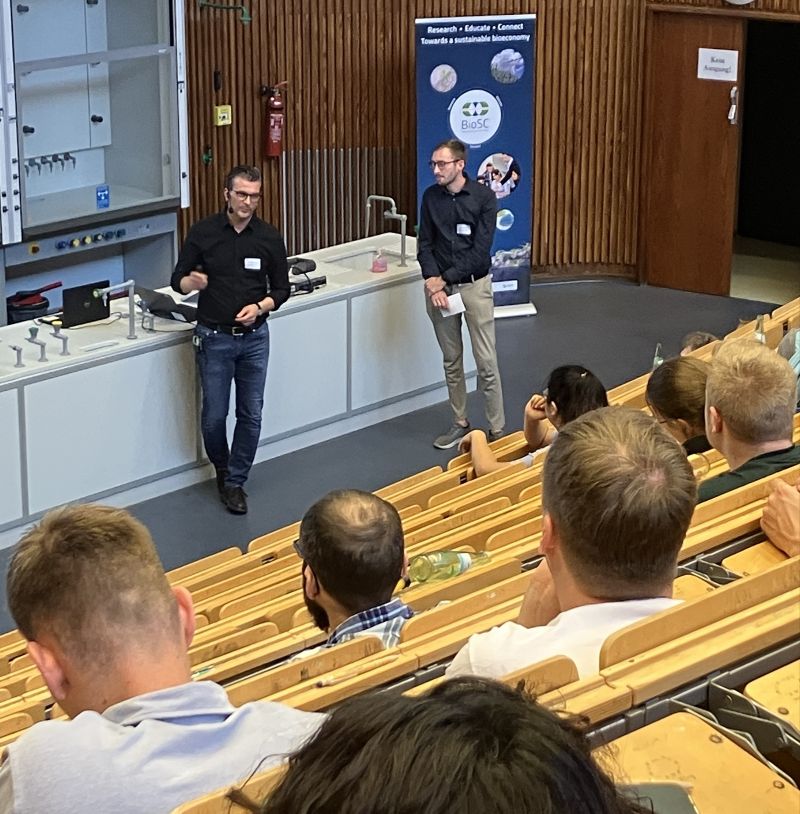
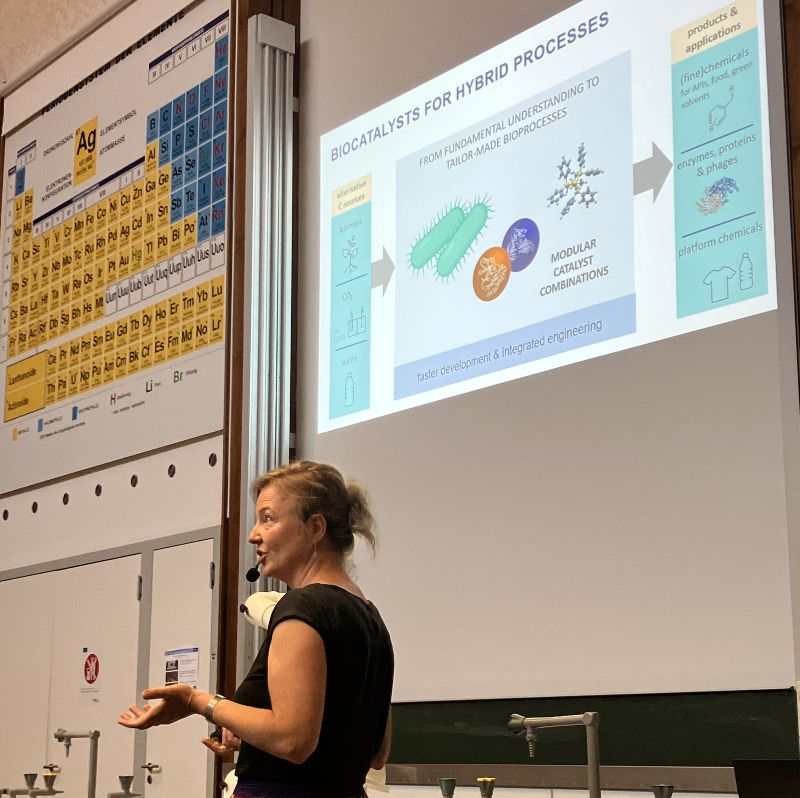

The event was hosted by the Chair of Bioinorganic Chemistry at RWTH Aachen University. In the keynote lecture, Walter Koch, BASF, used various examples to demonstrate that, in order to realistically determine whether a bio-based product actually reduces CO2 emissions, it is necessary to consider not only the manufacturing process but also raw materials, transportation, recycling, and disposal. Following this, various examples of new synthetic routes were presented. Caroline Paul, TU Delft, showed impressive possibilities for the production of fragrances and active pharmaceutical ingredients using enzymatic retrosynthesis. Dörte Rother, Forschungszentrum Jülich, illustrated how such enzymatic reaction cascades can be combined with microbial and chemical synthesis steps and how these hybrid processes can also be carried out in non-aqueous media. Jürgen Klankermayer, RWTH Aachen University highlighted the necessity and possibilities of concatenating different catalytic pathways for the realization of a circular economy.
In the second part, Johannes Rebelein of HHU Düsseldorf demonstrated that certain bacterial nitrogenases are capable of converting CO₂, which could be a promising approach for the production of CO₂-based chemicals. The event concluded with an impressive joint presentation by Sonja Herres-Pawlis and Andreas Jupke, both from RWTH Aachen University, who presented chemical processes for the synthesis and degradation of bioplastics on a technical scale, including innovative product recovery methods.
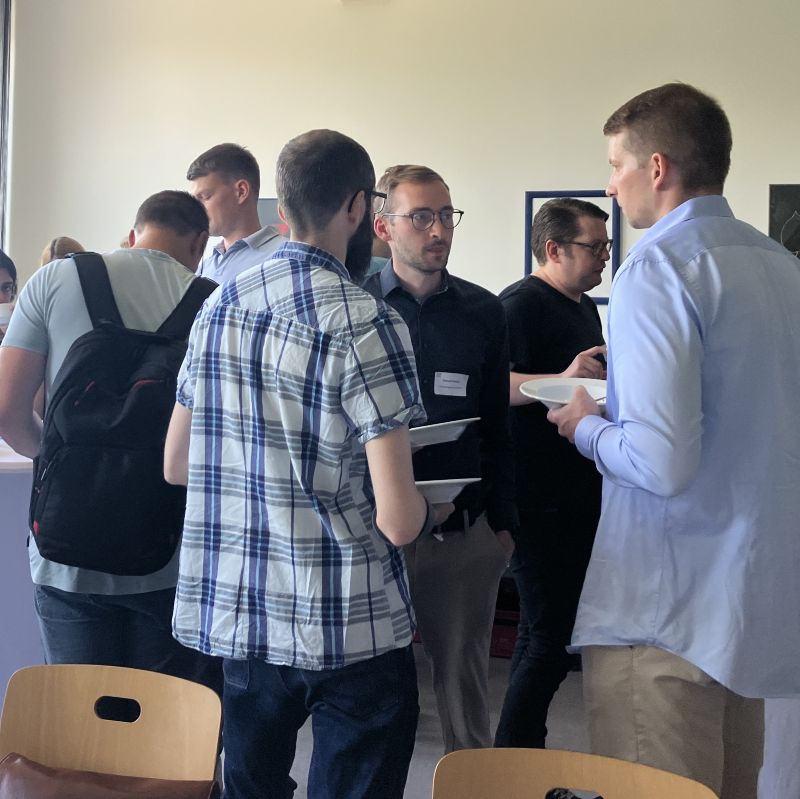
Intense discussions and networking rounded out this exciting and productive day. Many thanks to all the speakers, to everyone who helped organize the event, and to the participants!
|
11:00 h |
Registration and Light Lunch |
|
12:00 h |
Welcome |
|
|
Dörte Rother, IBG-1: Biotechnology, Forschungszentrum Jülich |
|
12:05 h |
Keynote |
|
|
Comparison of footprints of petrochemical and biocatalytic processes |
|
12:45 h |
Session I |
|
|
Moderator: Niclas Conen, IBG-2: Plant Sciences, Forschungszentrum Jülich |
|
|
Redox biocatalytical approaches for fine chemical targets |
|
|
Combining multi-enzyme catalyzed processes with chemical and microbial reaction steps |
|
|
Concatenated catalytic pathways to platform chemicals |
|
14:15 h |
Coffee break |
|
15:00 h |
Session II |
|
|
Moderator: Larissa Laurini, Institute of Inorganic Chemistry, RWTH Aachen |
|
|
Decoding and taming nitrogenases for CO2 conversion |
|
|
Bio-based polymers on a technical scale: Innovative synthesis and separation for circularity Sonja Herres-Pawlis, Institute of Inorganic Chemistry, RWTH Aachen / BioSC Andreas Jupke, AVT.FVT, RWTH Aachen / BioSC |
|
16:30 h |
Closing Remarks |
|
|
Andreas Jupke, AVT.FVT, RWTH Aachen / BioSC |
|
|
Get-together |
About BioSC
Contact
Imprint
Data protection
© BioSC
BioSC-Geschäftsstelle
c/o Forschungszentrum Jülich
52425 Jülich
biosc@fz-juelich.de